
You’ll hear this everywhere: “Google loves fresh content.”
But many people still wonder what that actually means and why it matters for SEO.
Fresh content isn’t about writing something new and leaving it untouched forever. It means you publish new information or update older pages so they stay accurate, relevant, and easy to use today. Google focuses on user needs, so it prioritizes pages that clearly address current questions.
When your site shows fresh content, Google quickly understands:
- The page is updated,
- The information matches what people search for now, and
In this post, we are going to cover:
- The real meaning of fresh content for Google
- Why fresh content improves SEO performance
- The types of updates Google considers valuable
- The changes Google chooses to skip
- Fast content refresh methods anyone can apply
- The SEO gains of keeping pages updated
- How user engagement affects search rankings
- How fresh content increases crawl frequency
- How updates expand search visibility
What is Fresh Content?
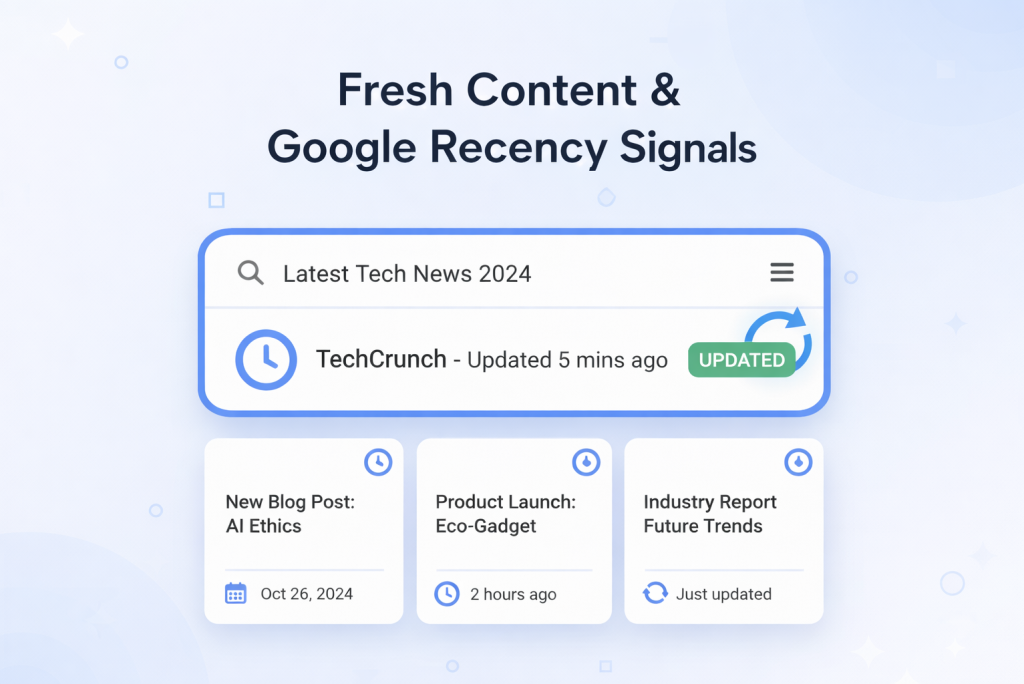
Fresh content means Google finds your page recent, updated, accurate, and useful for today’s searches.
It includes:
- New articles you publish
- Old pages you improve with current information
- Updated facts, tools, or examples that match what users search for now
Fresh content tells Google: this page serves real needs right now.
Why Fresh Content Boosts SEO?
Fresh content helps your website stay relevant and useful for searches. When you update pages or add new posts, Google sees your site as active and trustworthy. It also helps you use current keywords, attract more clicks, and keep visitors engaged. All of this tells Google your site deserves higher rankings, which brings more traffic over time. Google ranks pages that stay relevant. Fresh content helps SEO by improving four key signals:
1. More Keyword Visibility
Search trends change fast. When you update content, you add keywords people use today. This helps your page appear in more searches.
2. Higher Click-Through Rate
Users choose content that feels current. Fresh pages attract more clicks because they look reliable and timely.
3. Stronger Page Engagement
Updated content keeps readers interested. When users spend more time on your page, Google pushes it higher in results.
4. Improved Search Trust
Google favors pages that deliver accurate answers. Regular updates increase your site’s credibility and search performance.
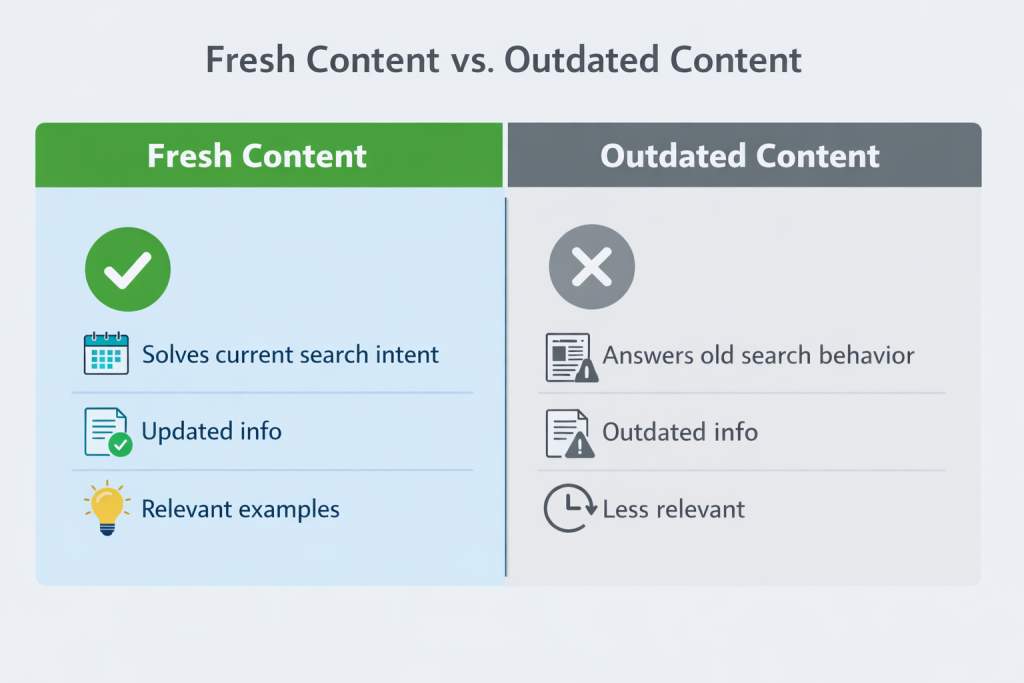
Fresh Content Vs Outdated Content
Fresh Content | Outdated Content |
Solves current search intent | Answers old search behavior |
What Counts As Fresh Content?
You can create fresh content in multiple simple, effective ways:
1. New Articles and Blog Posts
When you publish a new post on a topic people search for today, Google sees your site as active. One good article can open the door to a whole new audience. It doesn’t need to be long or complicated. It just needs to be relevant and helpful.
For example, if people are searching for local SEO tips, Google Business optimization, new ranking tools, or recent trends, and your blog answers those queries, that becomes fresh content that Google prioritizes.
2. Updating Existing Page
Older pages can become fresh again when you improve them with new details. Google treats updated content as fresh if it adds real value. You can update:
- old statistics
- outdated tools or references
- examples that reflect the current time
- images or infographics to explain faster
- internal links to help users explore more pages
A page updated from “Top SEO Trends 2024 → Top SEO Trends 2026” becomes fresh when the content inside is also improved. Simply changing the date isn’t enough, but improving the details makes a big difference.
3. Adding Multimedia
Adding visuals makes content easier to understand, and that increases engagement. When users understand faster, stay longer, and click more links, it strengthens your SEO performance too. You can add:
- screenshots
- short videos
- simple charts
- infographics
- icons or process images
Multimedia doesn’t just improve the look. It improves how people interact with the page, and Google pays attention to that.
What Google Doesn't Count as Fresh Content
Google ignores edits that don’t improve the content meaningfully. These include:
- Replacing only a few words
- Rewriting the same idea without adding anything new
- Inserting keywords without improving clarity
- Updating the publish date but keeping the content unchanged
Google is advanced enough to understand intent. It doesn’t rank tiny changes. It ranks improvements that help users better.
Why Google Cares About Fresh Content for SEO
Google’s goal is simple: give users the best answer for their search.
Since information changes constantly, Google pushes pages that evolve too.
Fresh content helps Google confirm that:
- Your answers reflect the present
- Your page serves the current search intent
- Users find the content useful and understandable
- People stay longer and interact more
Google tracks behavior. If users spend more time reading your content, click internal links, or revisit your site, it sends a positive ranking signal. This is why fresh content works as a growth booster for SEO.
How Fresh Content Helps SEO
SEO Benefit | How Fresh Content Supports It |
Higher Ranking Potential | Google boosts updated pages that solve current searches. |
More Organic Traffic | Fresh posts attract new readers and increase clicks. |
Better Indexing | Google crawls your site more often when pages improve regularly. |
Improved User Experience | Updates keep information accurate and easy to read. |
Fresh content impacts visibility, clicks, and engagement. These are major SEO pillars, and fresh content improves all of them.
You Can Start Writing Fresh Content Today - With Every Little Effort
You don’t need to build a complex plan to start. You can begin with small updates that matter:
Improve One Page
- Replace old references with new ones
- Add 2–3 fresh tips
- Break long text into short paragraphs
- Add one image to explain faster
Write One Popular Question Answer
Pick a question users ask often and answer it in 3–5 lines. Simple, direct answers increase your chance to rank.
Add One Current Example
Use real updates or trends that reflect the present time.
Make Your Headings Clear
Use titles that feel natural and updated, like:
- SEO Tools That Help You Rank in 2025
- Quick Tips for Better Local Visibility
- Updated Content Guide for 2026
These help users trust the page quickly, which increases clicks.
Use Active Voice
Write sentences like:
- “Google ranks updated pages faster.”
- “Fresh content attracts more clicks.”
- “Clear answers keep readers on your site longer.”
Active voice makes content stronger and easier to understand.
How Often Should You Refresh Your Content?
You don’t need to update daily. A simple cycle is enough:
- Update important pages every 3–6 months
- Publish one helpful post every 4–5 weeks
- Add examples when trends shift
- Improve instead of rewriting the same idea
Fresh content is about purpose, clarity, and timing, not pressure.
Conclusion
Fresh content means sharing new insights or improving older pages so they work for today’s searches. It helps SEO by increasing visibility, earning clicks, boosting engagement, and matching current search behavior.
The best part? You can start right now by updating one small section at a time, and still make a noticeable SEO impact.
If you want to turn those updates into long-term results, expert planning can speed up your growth and protect your rankings over time.
m dolor sit amet, consectetur adipiscing elit. Ut elit tellus, luctus nec ullamcorper mattis, pulvinar dapibus leo.
Soft CTA
Want content that ranks, engages, and stays relevant on Google? SamriOptimize builds practical SEO strategies that bring more visibility and long-term growth.